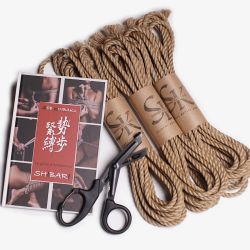
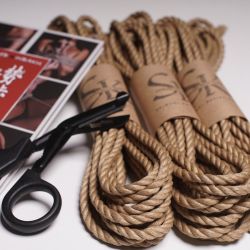
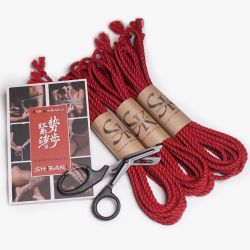
- Kit
In Stock

New to Shibari?
This selection is designed to help you start simply, with suitable ropes, beginner kits, and the essential basics to safely discover Japanese rope bondage.
Shibari, also known as Kinbaku, is a Japanese rope art based on trust, communication, and precision. Starting properly helps you learn more comfortably and avoid many common beginner mistakes.
Beginner Shibari should stay simple. Many people discover Japanese rope bondage through highly advanced photos or videos, but the foundations are usually much more minimal. Before trying complex ties, it is important to understand the basics: safety, rope tension, equipment choice, and communication with your partner.
Shibari, also called Kinbaku, is a Japanese rope art that combines technique, trust, and sensations. A good progression helps you learn more comfortably and avoid common beginner mistakes.
The choice of rope greatly changes the experience. A beginner Shibari rope should be soft enough, consistent, and comfortable on the skin to make learning easier.
Jute rope remains the traditional reference for Japanese rope bondage. It offers good grip and authentic sensations. Softer ropes can also be interesting for people looking for a slower and more sensory practice.
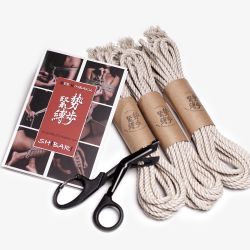
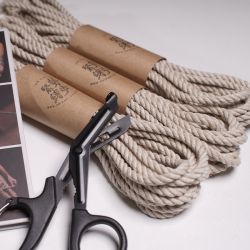
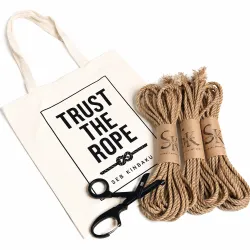
The beginner Shibari kits allow you to start with a coherent selection without having to choose every item separately.
Safety is the priority in Shibari. Even before aesthetics, you must learn how to practice safely.
Many beginners try to progress too quickly. Immediately reproducing complex ties seen online is often a bad idea. Shibari requires time, practice, and understanding.
Another common mistake is choosing unsuitable rope. A rope that is too stiff or low quality can make learning more difficult and less enjoyable.
Finally, many people forget that Japanese rope bondage is mainly based on communication and listening to your partner.
The first recommended tie is often the single column tie. This knot helps you understand rope tension, movement fluidity, and the basics of rope handling.
Before learning complex harnesses, it is better to practice simple and clean ties.
To begin Shibari, you only need a few things:
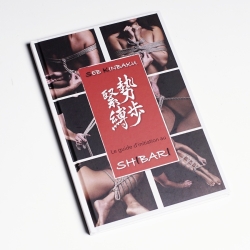
The Shibari guide also helps you progressively learn the basics and practice at your own pace.
A private Shibari lesson allows you to learn faster with personalized guidance. Movements are corrected directly, and progression is adapted to the student’s level.
It is often the simplest way to discover Japanese rope bondage in good conditions and build strong foundations.








Once the first basics are learned, many practitioners begin to understand that Shibari is not only about knots or ties. The quality of sensations, rope tension management, and communication gradually become the most important elements.
Japanese rope bondage requires time and practice. Even simple ties can become highly technical when working on fluidity, precision, or partner comfort.
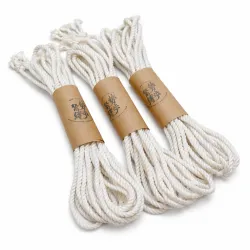
To begin Shibari, two to four 8-meter ropes are more than enough. This already allows you to learn basic ties, simple harnesses, and essential tension principles.
Many beginners buy too much equipment immediately. It is often better to start with fewer ropes of good quality in order to learn more comfortably.
In Shibari, the rope is an integral part of the experience. A pleasant rope to handle completely changes the sensations and the fluidity of practice.
Ropes used in Japanese rope bondage often have a specific texture that provides better grip and more stable tension. A rope that is too slippery or too stiff can make ties more difficult for beginners to learn.
Shibari relies heavily on listening and communication. Even before technique, it is important to discuss sensations, limits, and comfort with your partner during practice.
Good communication helps avoid unnecessary tension and greatly improves the overall Japanese rope bondage experience.
It is possible to learn some basics alone through guides and educational videos. However, guidance often allows faster progress and helps avoid technical mistakes that can later become difficult to correct.
Private Shibari lessons provide precise corrections adapted to each person’s level and pace.
No. Beginner Shibari can be discovered progressively by people with no particular experience. The most important thing is to start with simple foundations, suitable equipment, and a progressive approach.
Many practitioners first discover Shibari as a way to explore trust, connection, or communication even before the technical aspect.
The terms Shibari and Kinbaku are often used together. Shibari literally means “to tie,” while Kinbaku is generally used to describe a more traditional, emotional, or artistic approach to Japanese rope bondage.
Today, both terms are widely associated with the Japanese art of rope.
Over time, Shibari practice becomes more fluid and natural. Movements gain precision, tensions become cleaner, and communication gradually improves.
Starting simply with suitable ropes, solid foundations, and a progressive approach remains the best way to discover Japanese rope bondage in a lasting and comfortable way.
Cordes de Shibari · sélection Seb Kinbaku
Jute japonais, chanvre soyeux ou fibres alternatives : chaque corde possède un toucher, un toronnage et un comportement différents. Cette sélection privilégie la qualité, la sécurité et une prise en main cohérente, du premier nœud à la suspension.
Comprendre les différences en une minute
Une présentation courte pour repérer les différences de toucher, de souplesse et d’usage avant de choisir.
Une sélection née de la pratique
La corde SK a été créée pour Seb Kinbaku avec un artisan japonais de la région de Kyoto. Trois mois de travail, d’essais et de retours après utilisation ont été nécessaires pour obtenir une corde en longues fibres de jute, régulière et sans JBO. Son toronnage reste souple, mais il est plus serré que celui d’une Ogawa afin d’offrir davantage de stabilité et de précision.
Un jute japonais sélectionné pour sa régularité, sa prise en main et sa réponse sous tension. Le toronnage plus tenu résiste mieux aux manipulations répétées.
Voir la corde SKConnue depuis longtemps dans le Shibari international, l’Ogawa est extrêmement souple. Son traitement JBO produit une odeur qui peut déranger. Son toronnage très souple exige une manipulation précise, notamment en suspension dynamique.
Découvrir l’OgawaTrès doux sur la peau, léger en main et naturellement résistant, le chanvre soyeux dégage seulement une légère odeur végétale. Il ne demande aucun traitement et constitue un choix rassurant pour débuter.
Choisir le chanvreAu-delà des références japonaises, les fibres alternatives permettent d’explorer d’autres textures et sensations. Elles complètent la sélection sans remplacer les cordes principales utilisées pour l’apprentissage et la suspension.
Une fibre souple et légère, au toucher différent du jute traditionnel.
Une texture plus brute pour des usages au sol et des recherches sensorielles.
Une corde japonaise singulière, choisie pour sa matière et son esthétique.
La qualité SK avec une présence visuelle plus affirmée pour la scène et la photo.
Garder une corde régulière
Toutes les cordes de Shibari sont toronnées : cette construction leur apporte une excellente résistance à la traction, mais elle demande une manipulation attentive.
Besoin d’aller plus loin ? Retrouvez les guides et conseils Shibari de Seb Kinbaku.