Is Shibari Always Sexual?
Is Shibari Always Sexual?
When I tell people that I am a Shibari artist and instructor, one question comes up again and again:
“Is Shibari always sexual?”
My answer is no.
But that answer deserves some nuance.
Saying that Shibari is always sexual would be reductive. Saying that it is never sexual would be equally inaccurate. Eroticism is part of its modern history and remains present in many contemporary practices. However, it is neither compulsory nor the only possible purpose.
The meaning of a Shibari session depends above all on the context, the intentions of the people involved and the kind of relationship they choose to create through rope.
Shibari Can Be Sexual Without Always Being Sexual
Shibari and Kinbaku are often associated with BDSM, eroticism and power dynamics. This connection is real and should not be erased simply to make the practice appear more acceptable.
However, sexuality and BDSM are only two possible contexts among many others.
Shibari can be erotic.
It can also be artistic, relational, contemplative, performative or simply based on the pleasure of working with rope.
A single session may even combine several of these dimensions.
This distinction is essential because there is no single way to practise or experience Shibari.
What Do the Words Shibari and Kinbaku Mean?
The Japanese word shibari — 縛り — refers broadly to tying, binding or restraint created through a tie. It is not, in itself, an exclusively sexual term.
The word kinbaku — 緊縛 — more specifically refers to tight binding or close restraint.
In the contemporary rope community, the two terms are often used interchangeably. Some people distinguish them by describing Shibari as more artistic and Kinbaku as more erotic, emotional or relational.
This distinction can be useful when explaining a personal approach, but it is not a universal Japanese definition.
In my own work, I often use the word Shibari because it is widely recognised in France and internationally. However, the word itself does not define what will happen between two people.
It is the intention behind the rope that gives the session its direction.
A Necessary Note on the Japanese Origins of Shibari
Shibari is often described as an “ancient samurai art”.
This explanation is attractive, but historically it is far too simplistic.
Japan did have methods of capturing and restraining people with rope, commonly associated with hojōjutsu or torinawajutsu. These techniques belonged to martial practices and to methods of arrest used during feudal Japan and the Edo period.
Their purpose was to capture, control, restrain and transport a person.
Hojōjutsu was not a practice of connection, consent or personal development. The person being restrained had generally not agreed to the experience.
It would therefore be inaccurate to describe contemporary Shibari as the unchanged continuation of this historical system.
The influence of hojōjutsu is often mentioned, but the available historical evidence does not establish a simple, direct and uninterrupted line of transmission between these arrest techniques and modern Japanese rope bondage.
The precise origins and influences remain more complex.
Modern Shibari and Kinbaku are better understood as the result of several overlapping influences: historical images of restraint, rope techniques, theatre, illustration, photography, Japanese erotic culture and the development of Japanese SM culture during the twentieth century.
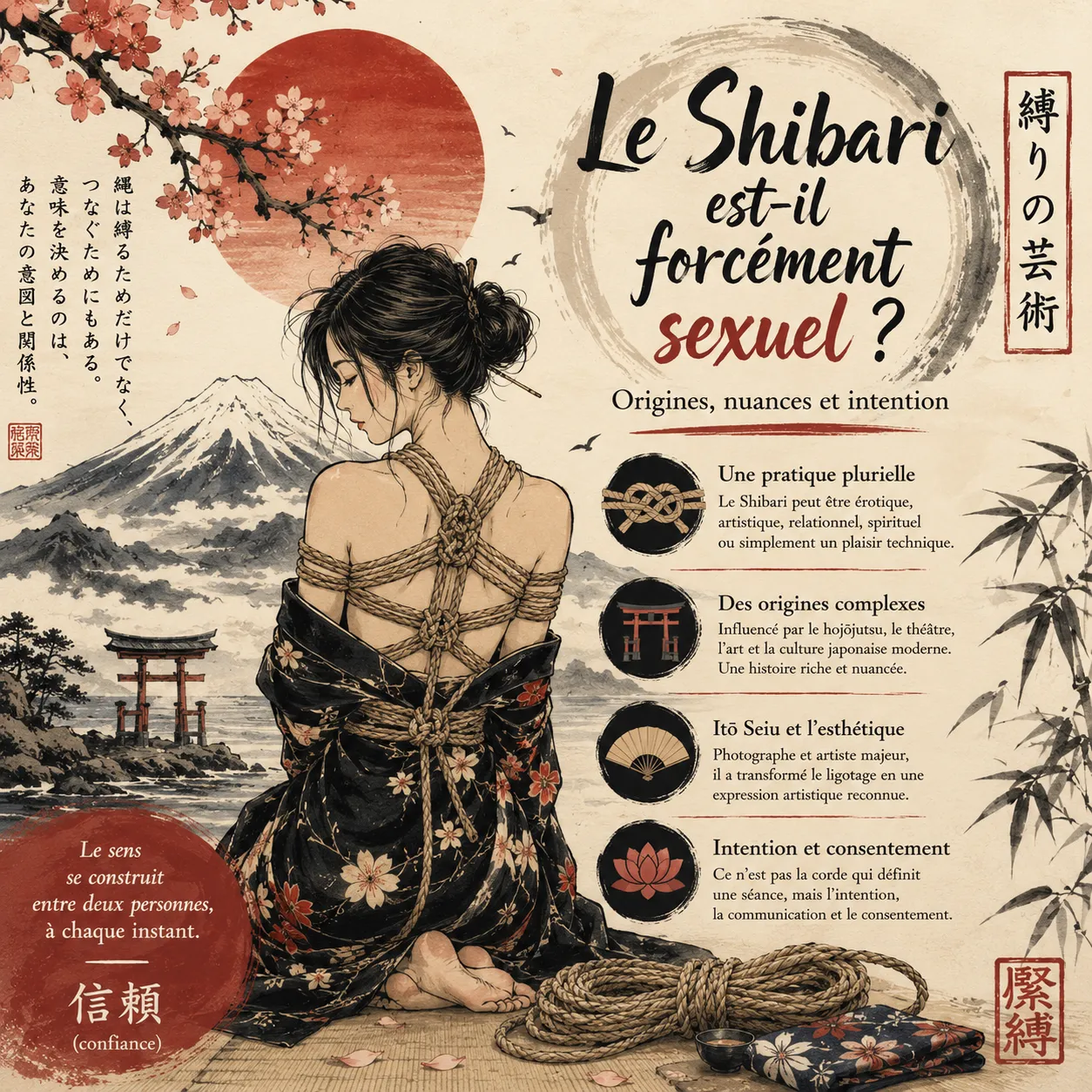
Itō Seiu and the Development of Modern Kinbaku
One important figure in this transformation was Itō Seiu, a Japanese painter born in 1882 and deceased in 1961.
He is frequently cited as one of the major precursors of modern Kinbaku.
Itō Seiu used tied models as references for some of his drawings and paintings. Photographs connected to his artistic work circulated during the early twentieth century and helped introduce rope into a modern artistic and erotic imagination.
This does not mean that one man alone “invented Shibari”.
A cultural practice rarely comes from one individual or one single tradition. It develops through successive influences, transmissions, reinterpretations and adaptations.
Modern Japanese Kinbaku therefore developed during the twentieth century by transforming certain historical images and techniques into a new artistic, erotic and performative practice.
In My Practice, Rope Is Above All a Language
Throughout my journey as an artist and instructor, I have met many different kinds of people.
Couples looking to rebuild intimacy and connection.
Artists and photographers drawn to the lines rope creates on the body.
People curious about what it feels like to tie or to be tied.
BDSM practitioners.
And also people looking for an experience of trust, presence, communication or letting go.
What they all share is not necessarily sexuality.
What they share is the relationship.
When I tie someone, I am not simply working with rope or repeating a series of knots. I observe their breathing, their movements, their reactions, their hesitation and what their body communicates, sometimes before words are spoken.
The rope then becomes a language.
It can question.
It can reassure.
It can challenge.
It can contain.
It can also simply create a shape, an image or a shared moment.
Can Shibari Be a Form of Personal Exploration?
My background in NLP and personal coaching naturally led me to pay attention to what happens beyond technique: trust, the perception of control, the ability to communicate a boundary, self-awareness and attention to the other person.
Some people may experience Shibari as an emotionally powerful moment or as a space for personal exploration.
It may encourage calm, introspection, presence or a stronger awareness of the body.
However, it is important to remain precise.
Shibari should not automatically be presented as therapy.
It may create a space for observation, emotion or reflection, but it does not replace medical or psychological care when such support is needed.
A Sensual Session Is Not Automatically a Sexual Session
Another common misunderstanding is the assumption that sensuality and sexuality are always the same thing.
A session can be slow, intimate and emotionally intense without aiming for sexual excitement or sexual activity.
The feeling of rope on the skin, physical closeness, rhythm, breathing and vulnerability may create a sensual experience.
That sensuality can exist by itself without needing to lead anywhere else.
Conversely, a session may be explicitly erotic when the people involved want it and have clearly agreed on that intention.
There is therefore no single correct way to experience Shibari.
What matters is that everyone involved shares a sufficiently clear understanding of the experience they are about to create.
Consent, Communication and Safety
Whatever the intention — artistic, relational, sensual, erotic or BDSM-oriented — responsible Shibari relies on three essential foundations:
consent, communication and safety.
Consent is not simply a “yes” spoken before the session begins.
It must remain freely given, informed, specific and reversible at any moment.
The person tying must also possess the level of skill required for what they are proposing.
Good intentions do not replace knowledge of anatomy, nerve risks, circulation, rope placement or emergency procedures.
Suspension in particular requires specific training and experience. It should never be treated as an obligatory step or as proof that someone is practising “real Shibari”.
Shibari is not measured by how high a body is suspended.
It is measured by the quality of presence, awareness and responsibility brought into the relationship.
So, Is Shibari Always Sexual?
No.
But its erotic dimension exists and forms an important part of its modern history.
Denying that would be just as reductive as limiting the entire practice to sexuality.
Shibari can be:
artistic;
relational;
sensual;
erotic;
BDSM-oriented;
performative;
contemplative;
or simply based on the pleasure of tying and creating something with another person.
The rope does not decide what the session will become.
It has no intention, desire or meaning of its own.
The people involved give it meaning.
And for me, it is precisely within that space — between one person’s intention, the other person’s experience and what the rope reveals — that true Shibari begins.
Historical Note
Academic research specifically devoted to the history of Shibari and Kinbaku remains relatively limited.
Many widely repeated stories within the rope community are based partly on practitioner accounts, visual archives and oral transmission.
The historical existence of hojōjutsu is documented, but a direct and uninterrupted lineage between those methods of restraint and contemporary Kinbaku cannot be presented as a proven historical fact.
Modern Shibari should therefore be understood as a complex twentieth-century development shaped by multiple artistic, erotic, cultural and historical influences.