
10 Good Reasons to Learn Shibari in Paris
10 Good Reasons to Learn Shibari in Paris
Shibari, sometimes called Kinbaku, is a Japanese rope practice that goes far beyond simply tying a body. It can become an artistic, sensory and relational experience built around technique, communication, consent and presence.
In my approach, rope is first and foremost a language. It can create shapes, communicate an intention, explore sensations and build a different kind of connection between the person tying and the person being tied.
As a Shibari artist and instructor, a former fashion photographer and a Master Practitioner in NLP, I do not teach knots alone. During my private Shibari classes in Paris, I help each person develop a practice that is more conscious, precise and personal.
Here are 10 good reasons to discover Shibari.
1. Develop greater body awareness
Tying or being tied requires constant attention to the body. Breathing, muscular tension, pressure points, changes in posture and reactions to the rope all provide valuable information.
By practising Shibari, you gradually learn to notice these signals instead of focusing solely on completing a technical pattern.
During my classes, I help you understand how to position your ropes, adjust their tension and observe your partner’s reactions. The goal is not merely to create a visually attractive tie, but to develop a genuine quality of presence.
2. Improve verbal and non-verbal communication
Shibari does not begin when the first rope touches the body. It begins with the conversation before the session.
What would you like to experience? What are your boundaries? What would you prefer to avoid? How will you communicate discomfort or ask for an adjustment?
During a session, communication also becomes non-verbal. A change in breathing, muscular tension, movement or silence can provide important information.
My background in NLP allows me to bring particular attention to observation, listening and the quality of communication. Good Shibari practice is not about guessing what the other person feels. It is about observing, asking and checking.
3. Explore letting go within a clearly defined framework
Being tied can offer an opportunity to experience a form of letting go. The person being tied temporarily agrees to place part of the control in their partner’s hands.
However, this experience can only be meaningful within a clear framework based on consent, communication and appropriate skills.
Letting go cannot be demanded. It may emerge when a person feels sufficiently heard, respected and safe to release some of their vigilance.
During a private Shibari lesson, I take the time to explain how to create this framework, define an intention and remain attentive to what is actually happening throughout the session.
4. Discover a different sensory experience
The contact of jute rope, changes in pressure and tension, warmth, rhythm and physical proximity create a distinctive sensory experience.
Shibari can be sensual or erotic, but it does not have to be. A session may also be artistic, contemplative, playful, relational or focused on body awareness.
The intention of the people involved gives meaning to the experience. Rope alone does not decide what a session will become.
5. Build mutual trust
Trust is often associated with Shibari, but it should never be taken for granted.
It is gradually built through consistent behaviour, respect for boundaries, attentive listening and the responsibility shown by the person tying.
Tying someone means taking responsibility for their comfort, monitoring their reactions and remaining able to adjust or stop the tie when necessary.
In my Shibari classes in Paris, I teach you how to develop this responsibility. A beautiful pattern can never compensate for poor communication or inadequate safety awareness.
6. Develop your artistic eye
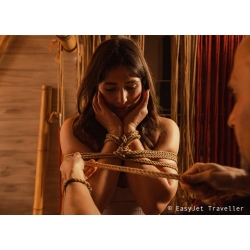
Shibari is also a visual art. The lines of the ropes, the areas left uncovered, the posture and the tension can transform the body into a living composition.
My experience as a photographer taught me to observe volume, balance, lines and the way a body occupies space.
This perspective directly influences the way I teach. I am not interested in imposing one fixed aesthetic. I help you understand the principles that will allow you to gradually develop your own eye and personal style.
7. Gradually move beyond your comfort zone
An introduction to Shibari may bring you into unfamiliar situations: touching differently, being observed, giving instructions, expressing a boundary or allowing yourself to slow down.
Moving beyond your comfort zone does not mean forcing yourself past your limits.
Responsible progress means exploring an appropriate level of challenge within a framework where you can continue communicating, adapt the exercise or stop at any time.
During my classes, I respect your pace and experience level. There is no need to rush or immediately attempt complex patterns in order to have a meaningful experience.
8. Learn precise technical skills
Learning Shibari requires precision. You need to understand knots, rope tension, direction, body placement and the risks associated with certain areas.
Technique should not be learned merely to reproduce a photograph found online. It should help you understand what you are doing, why you are doing it and how to adapt it to the person in front of you.
During a private Shibari class in Paris, we can work on subjects suited to your level, including:
- handling and organising your ropes;
- fundamental knots;
- tension and friction;
- simple floor ties;
- fluidity of movement;
- body positioning;
- communication with your partner;
- building a progressive and coherent session;
- reviewing your practice or analysing your own videos.
Suspension requires specific training and is not an essential step towards practising meaningful or authentic Shibari.
9. Meet a community and share a practice
The Shibari community includes people with many different motivations: artistic expression, technical learning, sensory exploration, BDSM, photography, performance or the desire to create a new form of connection.
Workshops, events and community gatherings can provide opportunities to exchange ideas, practise and discover different approaches.
However, it is important to choose your instructors carefully. Technical experience, teaching ability, respect for consent and the willingness to discuss risks openly are essential criteria.
10. Find your own way of practising Shibari
There is no single correct way to experience Shibari.
You may be drawn to its aesthetic qualities, its relational dimension, its intensity, its slowness, its sensuality or simply the pleasure of working with rope.
My role as an instructor is not to restrict you to one vision. I want to give you foundations strong enough to understand the practice, make more informed choices and gradually create your own language with rope.
Technique provides structure. Your intention, attention and personality then give that structure its direction.
Why choose a private Shibari class in Paris?
A private Shibari lesson allows you to progress at your own pace, based on your experience and what you genuinely want to learn.
Unlike a group workshop, the content can be fully adapted to your needs. You can attend alone, as a couple or with your regular practice partner.
A private lesson may help you:
- discover Shibari as a complete beginner;
- learn how to tie or explore the experience of being tied;
- improve your technique and correct existing habits;
- develop greater fluidity and presence;
- work on trust and communication as a couple;
- better understand consent and boundaries;
- bring more intention into your movements;
- build a coherent and progressive rope session;
- explore an artistic, sensual or relational approach.
I guide you without judgement, using a structured teaching method and paying close attention to safety, the body and the relationship between partners.
My vision of Shibari: going beyond the ropes
What drives me in Shibari is not limited to successfully completing a knot or reproducing a pattern.
What interests me is what develops between two people: intention, trust, attention, responsibility and everything that may be communicated without words.
When I tie someone, I observe their breathing, movements, reactions and subtle physical changes. Rope then becomes a way of communicating.
It can contain, reassure, question, create a sensation or simply draw a line across the body.
This is the approach I share during my classes: precise technique that always remains in service of the human experience.
How can you start learning Shibari in Paris?
To begin, it is preferable to attend an introductory Shibari class with an experienced instructor. This allows you to learn essential techniques, understand the main safety principles and avoid reproducing inappropriate ties found online.
You do not need any previous experience, exceptional flexibility or a particular body type.
A first lesson introduces you to the ropes, fundamental movements, simple ties and the way partners communicate before, during and after a session.
My private Shibari classes in Paris are tailored to your level, expectations and the type of practice you would like to explore.
In summary: why should you learn Shibari?
Shibari is a rich practice that can bring together technique, art, sensation, communication and human connection.
It can help you develop greater awareness, precision, listening skills and a more conscious way of communicating. It also requires time, knowledge and genuine responsibility.
Whether you are interested in the aesthetics of Kinbaku, curious about the experience of being tied, eager to learn how to tie someone or looking for a new form of connection, a personalised class will help you build foundations suited to your goals.
Would you like to discover Shibari in Paris?
I offer private Shibari classes in Paris for complete beginners as well as experienced practitioners who want to improve their technique, fluidity, communication and personal vision of rope.
Each session is designed as a personalised learning experience that respects your pace, your boundaries and what you genuinely wish to explore.
Linked products